
More than one in five deliveries in Dubai are done by Cesarean Section. A lot of women – couples are trying to find the right answer to the question; “What is the best way to deliver my baby if I had one previous Cesarean Section ?”
Recently the American College of Obstetricians updated its guidelines regarding vaginal deliveries after cesarean section (VBAC). The new guidelines are less restrictive. The main changes are in respect of where mothers should give birth and what are the group of mothers who should be considered for a VBAC or TOLAC (trial of labour after a cesarean section). This change has already started attracting media attention.
Recently the American College of Obstetricians updated its guidelines regarding vaginal deliveries after cesarean section (VBAC). The new guidelines are less restrictive. The main changes are in respect of where mothers should give birth and what are the group of mothers who should be considered for a VBAC or TOLAC (trial of labour after a cesarean section). This change has already started attracting media attention.
Most of the obstetric organisations in the world (ACOG – USA, RCOG – UK, SOGC – Canada, RANZOG – Australia) have a similar approach stating that “delivery is recommended at an establishment that can offer immediate delivery if needed ” .
In the US, most likely due to the high risk of medicolegal action, it led a large number of smaller hospitals to refuse care to women who had a previous ceasarean section ( CS ) and wanted to try for a vaginal delivery. The new approach by the ACOG supports the mothers autonomy of decision as to where and how she should deliver her baby. At the same time it gives a lot of emphasis in the counselling process and information provision. This is extremely important as you can only make an informed choice when you have the right information.
In Dubai most of the large private hospitals are able to offer care to women who wish to try for a VBAC. All women should have the opportunity to discuss with their obstetrician how they would like to deliver. So take your time and discuss it with your doctor and formulate your birth plan. This is my suggestion as to how you should approach your consultation / decision making;
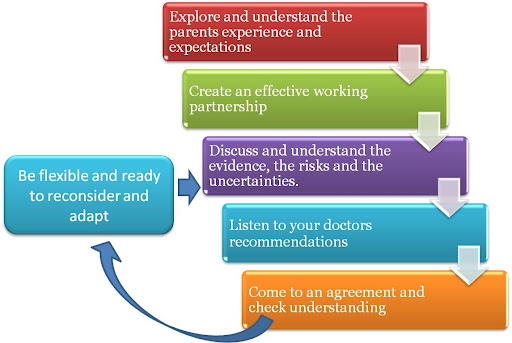
1. Your doctor should try and explore your previous experiences and understand your expectations. A lot of the decision making is coloured from what happened last time. Some mothers feel traumatised from a prolonged and unsuccessful labour and do not want to go through the same again. Others feel that they missed out on their opportunity for a vaginal birth and really want to try their best to achieve a vaginal delivery.
2. One of the advantages of private care is the opportunity and the time to build a working partnership between the parents and the doctor. So take full advantage of it and utilize it to help you make up your mind.
3. Discuss the evidence and try to understand its strengths and its weaknesses. It is important to understand the uncertainties particularly when you try and tailor the available evidence to a certain case.
4. Listen to your doctor’s recommendations. In addition to the widely accepted evidence they should reflect the local realities. It is good to read the evidence on the internet but implementing them at a local level is different and your doctor will be the best person to advise you on this.
5. Come to an agreement This includes checking that everybody fully understands what is decided.
6. Always be flexible ready to reconsider and adapt. Pregnancy and in particular labour are dynamic developing scenarios. The main objective though remains the same ” a healthy mother and a healthy baby”. Parents need to be ready to reconsider and adapt as the situation changes. Typical examples are; ” what do you do if while you decided for an elective CS you present to labour ward in advanced labour ? ” , ” what do you do if while you decided to go for a VBAC you labour you have 40 weeks and nothing happened ?”
In my experience the parents approach varies from one couple to another. Some parents come with a clear plan while others may need time to come to formulate in their mind what they feel is best for them.
You might find helpful the following basic statistics.
·The overall chance of a successful VBAC is between 70-80%. This is an overall figure . Your doctor should be able to adjust this figure and give you an assessment tailored to you. There are a number of factors that increase or decrease your chance for a successful vaginal birth after cesaerean section. Your past obstetric history (what happened in your last pregnancy), your medical history, the progress of the current pregnancy, how your labour starts are all factors that make a difference.
·Risks; whatever you decide to do you need to have a good idea of the risks for you and your baby.
Labor is a risky time of a woman’s and her baby’s life. Whichever mode of delivery you choose there are some risks.
Elective cesarean section to deliver your baby after one previous Cesarean section;
·It is more likely that you will stay in hospital longer and will need a longer time for recovery. You have to recover from a major surgical procedure.
·There is increased risk for surgical complications like injury of the bladder and the bowel. The more cesarean sections you have the more likely to run in these troubles. After every operation during the healing process you create adhesion (organs and tissues sticking together). This makes future operation in the same site (like a repeat CS ) more risky.
·There is increased risk to have problems in future pregnancies. These mainly have to do with the location of placenta and the risk for it to become very adherent to the womb (placenta accreta).
·Your delivery is more likely to be by CS next time as well.
Vaginal birth after one previous Cesarean section – successful
·There is a risk for uterine rupture. The chance for this happening is small (0.5%) it can lead to serious problems for both mother and baby.
·There is a risk for complications during the labour. Sometimes these can be serious. The risk for perinatal death or hypoxic encephalopathy (brain damage) is almost 0.5/1000.
·With every vaginal delivery there is a risk of vaginal tear and significant perineal (this is the area between the vagina and the back passage) trauma.
Unsuccessful trail of labour after one previous Cesarean section
The worst of both worlds suffer those who try for a vaginal birth but fail and end up with and emergency CS.
·Every operation performed in and emergency setting is more risky that an elective -scheduled one. As a result of that all the risks mentioned for the elective CS are increased in this scenario.
·Furthermore it is more likely to have a large bleed that requires transfusion, or ends up to a hysterectomy.
·More likely to have an infection.
·More likely to have to stay in hospital for longer and take longer time to recover.
I hope you find this info useful
Dr George Michailidis
FURTHER READING
RCOG information leaflet; Birth after previous Caesarean Section
ACOG patient education leaflet; Vaginal birth after Cesarean Section
Dr George Michailidis, Obstetrician and Gynecologist
Fetal and Maternal Medicine Consultant


Pingback: The value of birth plan, advice how and why you should prepare one. | Pregnancy in Dubai