Twin pregnancies (as well as higher order multiple pregnancies) have been on the rise. Medical interventions , like ovulation drugs and IVF treatment have been the main reasons for the increase in multiple pregnancies the recent decades. The needs and the care of mothers who are carrying twins are different compared to those of a singleton (one baby ) pregnancy. Furthermore all twin pregnancies are not the same. It is very important to know the type of twins you are carrying as this has major implications in the management and care of the pregnancy.
The best time to determine the type of twins is in early pregnancy (usually 10-13 weeks). What you NEED to know is if your twins are monochorionic or dichorionic. Not so much if they are boys or girl, identical or not. Determining chorionicity is essential for the proper management of your pregnancy. Ask your doctor to make a clear documentation of your babies chorionicity.
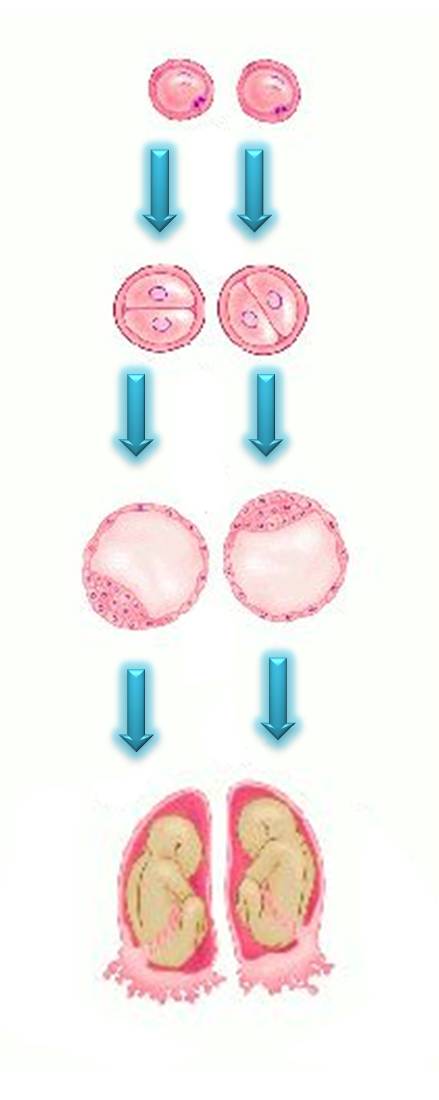
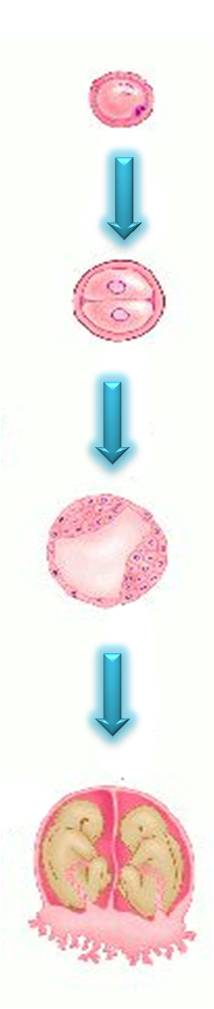
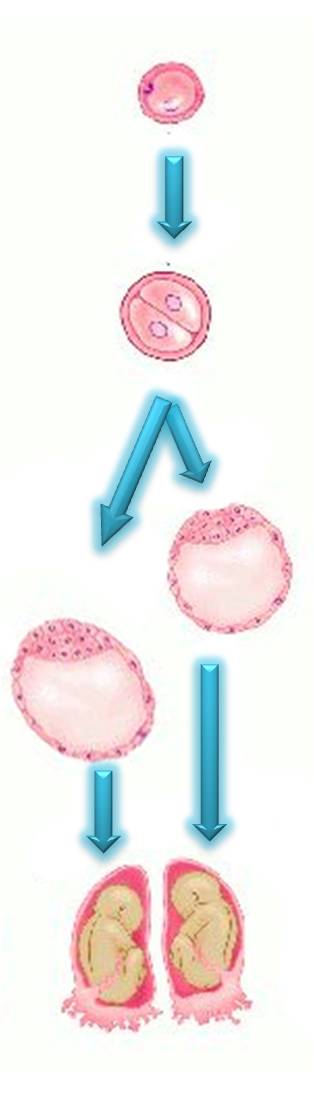
The following diagrams describe the different type of twins.
 |
| Dizygotic (fraternal , not identical ) twins |
Dizygotic (fraternal or not identical) twins are the most common type of twins (79%). Two oocytes (eggs) are fertilized by two sperm cells and form two embryos that are like brothers or sisters. These babies although similar (as siblings) are not genetically identical. They can be either the same or different gender. Each baby has each own placenta. Sometimes the two placentas fuse as they develop one next to the other. The two placentas do not communicate between them.
These are the type of twins you most commonly have after IVF as two fertilised embryos are returned into the womb.
All dizygotic twins are dichorionic (with few rare exceptions).
 |
| Monozygotic (identical ) monochrionic twins |
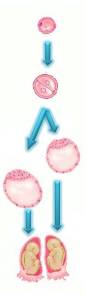 |
| Monozygotic dichorionic twins |
Monozygotic (identical) twins. Their frequency is about 4.5 per 1000 pregnancies. In this case one sperm cell fertilizes one oocyte (egg). The embryo that forms subsequently splits in two. These babies are genetically identical and are always the same gender.
The most common type of identical twins are monochorionic diamniotic twins (70-80%). Imagine one balloon (the chorion) containing two smaller balloons (the amnion) each one with a baby inside. The two placentae communicate between them (blood can go from one baby to the other)
In about 20-25% when the embryo splits early (days 0-3) you have monozygotic dichorionic twins. These twins although they are genetically identical each one has each own placenta and there are no
significant communications between
them.
 |
| Monozygotic monochorionic monoamniotic twins |
A rare type of monozygotic ( identical) twins are those who are in the same sac. They are called monoamiotic. This happens when the embryo splits in two after day 8. Only about 2% of monozygotic twins are monoamniotic. These babies share the same placenta
If the split takes place after day 12 the results are the various type of conjoined twins.
The reason why it is so important to determine the type of twins you carry is a syndrome called twin to twin transfusion syndrome (TTTS). Twin to Twin Transfusion syndrome is unique to monochorionic (MC) multiple pregnancies. It complicates up to 1/5 of MC twin pregnancies. If severe and left untreated it leads to the loss of both babies.
Your obstetrician in Dubai should let you know from the outset the type of twins you carry and based on that draft a plan for the management of your pregnancy.
The following are, in my opinion, important parts of the care and in our Fetal Medicine Unit we ensure we spent ample time to discuss them with the parents;
- Screening for chormosomal anomalies
- Nutrition and diet.
- Monitoring for twin to twin transfusion syndrome in monochorionic twin pregnancies.
- Risks and monitoring for preterm delivery. In Dubai it can be proven very difficult (and costly) to manage very premature babies. This is an important part of you care and should be fully discussed to ensure you reach informed choices about your care.
- Monitoring for growth It is good practice each time you have an ultrasound scan to get a typed report that clearly documents the findings and type of twins.
- Timing and mode of delivery
I hope you find this helpful
Dr George Michailidis MRCOG
Specialist in Fetal & Maternal Medicine
Consultant Obstetrician & Gynaecologist