
In pregnancy mothers undergo a large number of tests, many times without actually fully appreciating what each test is about. In particular screening and diagnostic tests for Downs syndrome T21 can end up causing a lot of anxiety.
It would worth thinking and discussing with your partner and your doctor the following questions;
- Is this a relevant test? In other words would it change the way you view this pregnancy?
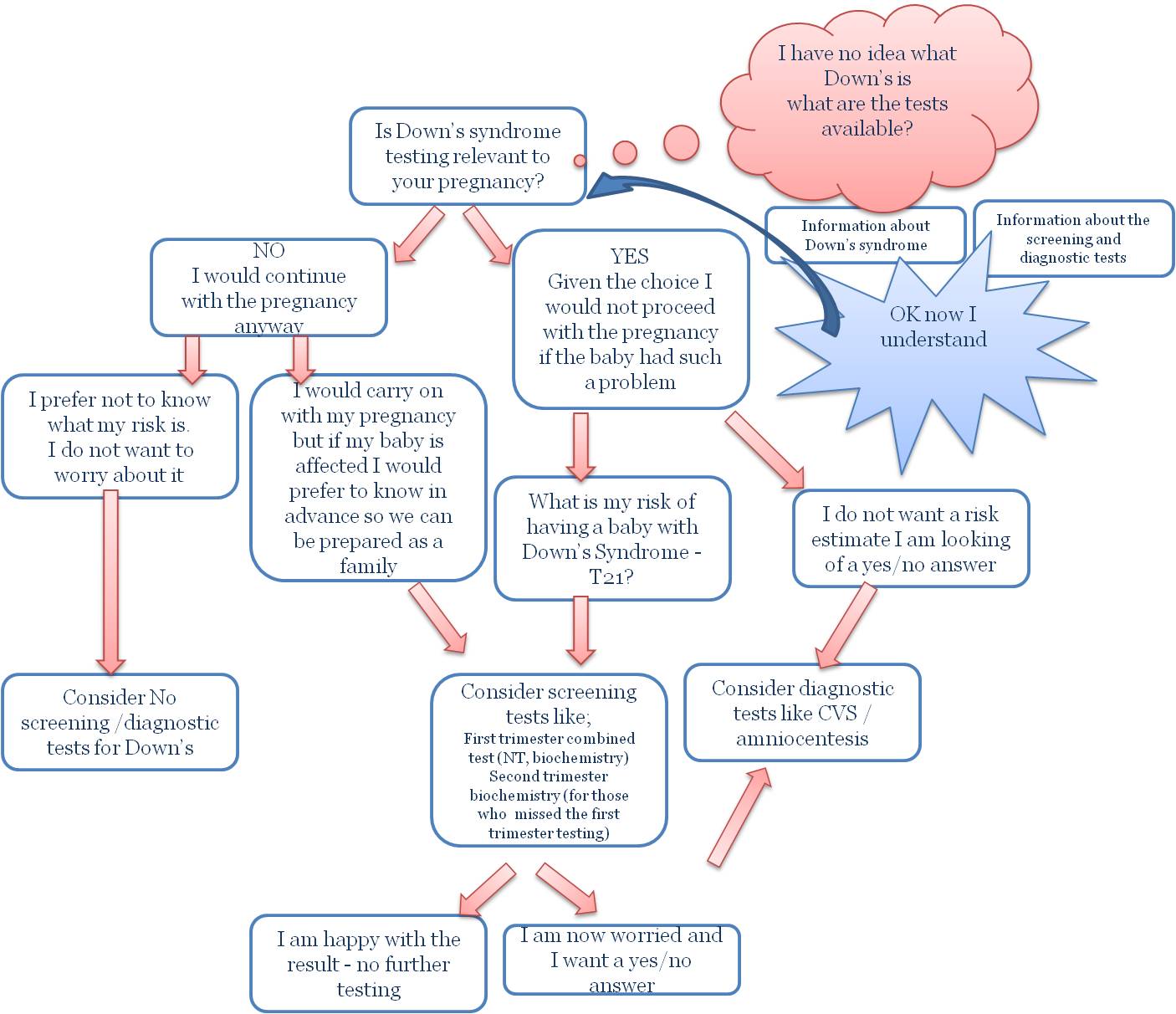
Usually parents do come in 3 big groups;
Those for whom whether the baby has or not Downs make no difference what so ever. These parents would not consider termination and they would look after the baby the same way as any other baby would come their way.
Those parents who believe that given the choice they would not bring to life a baby with such a problem.
Those that say “Doctor I have no idea what I would do. Lets discuss what are the chances of this happening to help us make up our mind how will go forward”
For the first group testing for Downs may not be appropriate. It may result in extreme anxiety if the results are not reassuring without any real benefit for the overall pregnancy management.
I should point out here that although the majority of parents in this group would prefer not to know and worry, a small number would opt to undergo testing as they would like to be prepared (psychologically, making appropriate family arrangement etc..)
In the second group usually we see a number of parents that are looking for absolute certainty. They do not want a risk estimate but a “yes or no” answer to help them early make arrangement for the pregnancy management. For these parents diagnostic tests like a CVS or an amniocentesis should be considered.
The third group contains the majority of parents and they should try and think the following;
- Is there a risk level that will make you feel content and secure?
Unfortunately the results of screening tests give a risk estimate. The cut off points are usually set anywhere between a risk of 1/250 to 1/300. So a result 1/299 – abnormal – high risk result is statistically not different from the 1/301 – normal- low risk result. Dealing with the results of the test is challenging for everybody and you should spend some time with your doctor discussing these issues. - Avoid the question “doctor what would you do in my case?“. Each family has a unique setting. Even within the same family the circumstances change over a period of time. The role of you doctor in most of the cases should not be to tell you what to do but to give the information you need to help you make up your mind what is right for your family.
The following flow chart is summarising the decision making process
 |
| Dr G Michailidis |
Make sure you have some quality time with your doctor and discuss the issues above.
Remember for most of these questions there are no universally “right” answers. The correct plan is the one that is appropriately tailored to you and your family.
Dr George Michailidis, Obstetrician and Gynecologist
Fetal and Maternal Medicine Consultant


Pingback: Nuchal translucency and screening for Down’s syndrome in Dubai. | Pregnancy in Dubai