Pregnancy in Dubai

Advice & information on common pregnancy problems by a Fetal & Maternal Medicine Consultant


Leave a comment

Screening for Down’s syndrome in twin pregnancies.

Screening for Down’s syndrome in twin pregnancies.

Twins and higher order multiple pregnancies are increasingly becoming more common. Fertility services have had a major impact in the changing incidence of multiple pregnancies. 
This is especially true in Dubai. Social pressures to achieve pregnancy quickly, private medicine practices, higher average income; all make couples more likely to see a fertility specialist.
Having some of the best fertility specialists practicing in Dubai and the neighbouring emirates results in more twins and multiple pregnancies. 
Twin and higher order multiple pregnancies pose extra challenges even for the best obstetricians when it comes to screening and diagnostic tests forDown’s syndrome (T21). 
1. Age related risk 
In Dubai the female population has its own distribution with more mothers in the age group of 35 -40. This is due to the structure of the expatriate group who tend to be higher end professionals and their families at their peak of their carriers. Screening and diagnostic tests for Down’s syndrome T21 are even more important for these mothers due to their high background risk (age related) for chromosomal anomalies. Twins naturally tend also to be more common in mothers of advanced age. 
2. Twins; double the risk ?

 
As we mentioned at an earlier blog for twin pregnancies determining thechronicity (i.e. monochorionic or dichorionic twin pregnancy) is of paramount importance. Without getting in detail about pregnancy complications like twin to twin transfusion syndrome regarding the risk for T21 you should know the following;
a. Monochorionic twins ; they are identical twins. One embryo splits at an early stage resulting in 2 fetuses (babies). Both babies have the same genetic information and the risk for T21 (Down’s sydrome) is THE SAME as if there was ONE only baby.
b. Dichorionic twins; they are most commonly fraternal – non identical twins (90%). The risk for each one of them being affected by T21 is calculated individually meaning each baby has its own risk.
The risk for ANY ONE of them being affected by T21 is the calculated by ADDING the two risks. 

baby one risk 1/100  baby two 1/200  calculated risk 3/200 1.5/100  approx 1/66
3. Nuchal translucency in monochorionic twins

In monochorionic twins increased nuchal translucency in one baby can be a sign of twin to twin transfusion syndrome.
4. What about the blood tests for Down’s syndrome?
Although they seem to improve somewhat the overall results of the test their influence is not as strong as in singleton pregnancies. Only recently publications dealt with reference range specific for twins. Their results must be very carefully interpreted. 
In cases were pregnancy has started as twin and one of the babies has not developed – miscarried, blood tests for Down’s syndrome may give very misleading results. 
First trimester screening by using the nuchal translucency and other markers (nasal bone etc) is the best option for screening for Down’s syndrome.
First trimester ultrasound scan that screens for major structural anomalies, determines the chronicity, determine the gestational age and screens for T21 is your best option. 
4. What are you going to do faced with a positive high risk for Down’s result?
This should be best discussed with your Doctor before the test. Good Obstetricians will explain your options for both the best screening and diagnostic tests. The screening should be performed by the best qualified professionals.
A fetal medicine specialist should be involved when diagnostic tests like amniocentesis or chorionic villus sampling CVS are considered due to the complexity of the procedures and the increased risks.
Discuss screening with your Obstetrician / Fertility Doctor. They should be able to give you good advice and refer you to a reliable Medical Institute for screening.
Dr George Michailidis, Obstetrician and Gynecologist 
Fetal and Maternal Medicine Consultant 

Leave a comment

Amniocentesis services in Dubai

Amniocentesis is a diagnostic procedure commonly performed at the Fetal Medicine Unit of the American Hospital Dubai. In this post you will find useful information that you should read and is best to discuss with your obstetrician during the preparation for an amniocentesis.

What is an amniocentesis?

Amniocentesis is a diagnostic procedure performed during pregnancy. It helps to obtain a small sample of amniotic fluid (the fluid around the baby) which in turn is usedfor the diagnosisof certain genetic conditions or infections.

Why should I have an amniocentesis?

An amniocentesis is not a routine test. Your doctor may offer youan amniocentesis if there are concerns about specific genetic conditions. The following are typical examples;
  • The one most widely knowngenetic problem is Down’s syndrome. A number of screening tests are available to help parents and obstetricians determine the riskof a pregnancy being affectedbefore deciding for an amniocentesis. The best test to date is the combined first trimester screening. This is part of the first trimester scan.
  • In some cases, the test is doneto excludeknown genetic problems that run in the family.
  • Routine ultrasound scans on occasions pick up certain features of the baby associated with genetic conditions.
  • Some parents wantto be certainthat their babyis not affected by a certain disorder.
  • An amniocentesis may also be offered to check whether an infectionhas passed from mother to the baby.


How is anamniocentesis done?

The procedure is best done after week 15 of your pregnancy. The doctor will fully explain the procedure and get you
to sign an informed consent.

 
He will checkyour blood group, your HIV and HepB status. If youare Rh Negativeyou will need an injectionof Anti-D after the procedure.If youare HIV or Hep-B positive, having the procedure may increase the risk of passing the infectionto the baby.


Usually the doctor will performprior to the amniocentesis an ultrasound scanto examinethe babyand identifythe best window for the procedure.
It takes a few minutes to prepare the proceduretray. Then he will clean your tummywith an antiseptic solution. A small amount of local anaesthetic will be usedto numb the skin where the needle is to be inserted. A thin needle is usedfor the local anaesthetic youmight find this a bit uncomfortable.

Following the local anaesthetic and under direct ultrasound guidance, the doctor will passa fineneedle through your tummyinto your womb and the fluid around the baby. The doctor’s assistantusing a syringe will obtainabout 15mls of this fluid. The babywill not miss this fluidand will replace it in a few hours. As a verythin needle is used, it takes a few seconds to takethe sample. At the end of the procedure, the doctorwillremove the needle.

Most women find the whole procedure uncomfortablerather than painful. On occasions, youmight experience mild period like pains. This not uncommon and simpleparacetamol is very helpful.

In some occasions, not enough fluid is obtainedwith the first attempt. This is usuallydue to the position of the baby. In this case, the doctor may have to reinsert the sampling needle.

What information will Igetfrom an amniocentesis?

This will depend on the why the test was performed.

In most cases, the aim is to examine the baby’s karyotype (genetic information).
Within the fluid withdrawn, there are cells that come off the baby’s skin. These cells (unlike our outer skin cells) are alive and can be cultured in the lab. After they are culturedto increase their number and getmost of them to startmultiplying, using specialtechniques, the geneticist will look at these cells under the microscope. The karyotype is a snapshot of the baby’s chromosomes. The geneticist will counttheir number(they should be 46) and examinetheir morphology (how they look). Usually, due tothe time it takes to culture the cells, this test is readyin 14 days from when it reaches the lab.

If more specialized genetic tests need to be performed it might take longer.Your obstetrician should be able to letyouknow of the approximate time before the testis done.

Rapid tests that only look at certainchromosomes in a small number of cells (FISH- PCR) are available
. These tests usually take48h after the fluid reaches the lab. Ouradvice to all is to have the fullkaryotype in addition to the rapid tests.

These tests in the vast majority of cases will givea definitive answer whether the baby is affectedor not from the disorder youwere testing for.


Pleasenotethe following;

The test will givea resultfor a specific condition.
It does NOT guarantee that the babydoes not have other genetic disorders.

Rarely whilethe test was performedto excludeone problem it picks up another unexpected one. Your Obstetrician, sometimes with the help of a geneticist, will help youto understand the results and their implications for your baby.
Rarely (less that 1/100) the cells do not grow well in the lab and the testcannot givea result.A repeat test may be necessary.

What are the risks for my pregnancy?

Unfortunately, the amniocentesis is not without risks. It is quotedthat there is a risk of 1% having a miscarriage as a result of the test. In ourexperience, this riskhas been much smaller (about 0.5%)

In a small number of cases (1:1000), a serious infectionmight develop.

Youshould carefully consider these risks against the value of the information youseektogetfrom the test.

The team will also explain to you; How you will receive your results.
What if my results areabnormal?

Although in many of the cases, the results will come back as normalthere will be those that are going to be affected by the conditionwe were testing for.


Youshould be aware that a termination of pregnancy is only allowed in exceptional cases at the UAE. Getting authorizationcan be a lengthy process.

We hope youwill find this information useful. If youhave any questions, you can contact either Dr Michailidis or our specialist midwife.

Dr George Michailidis, Obstetrician and Gynecologist 
Fetal and Maternal Medicine Consultant 


4 Comments

What is a screening test? what is the difference from a diagnostic test?

(The following is an extract from our Fetal Medicine information sheet for Downs Syndrome.) 

Screening tests give as a result a risk estimate, in other words how likely it is for a person to have a certain condition. This is usually expressed as a numerical value for example 1:100. Many times for simplicity if the risk is higher than a certain value the test is reported as “high risk” or “low risk” if it is lower than the threshold selected. 

Screening tests do not confirm or exclude a condition. For example a screening test does not say that a baby “has” or “has not” Down’s syndrome.
They do however, provide valuable information to help the parents decide if they want to proceed with diagnostic tests.

Diagnostic tests are those that confirm or exclude a condition.
If the screening tests do not tell us “yes or no” why don’t we just have the diagnostic tests ?
Today the available diagnostic tests for Down’s syndrome are
1.Chorionic villus sampling CVS
2. Amniocentesis
Both tests carry a small risk of causing a miscarriage (0.5-1%).
For this reason many parents would opt to have first a screening test and use the results to help them decide if they would proceed to a diagnostic test.
What are the recommended screening tests?
In the past the main screening test for Down’s syndrome was the mother’s age. Unfortunately this was proven to be neither very sensitive (picked up about 60% of babies with T21) nor very specific (too many women had to have unnecessary invasive procedures).
 At the American Hospital Dubai we recommend;
1.First trimester combined test. This test combines the results of first trimester ultrasound scanning (Nuchal translucency, fetal heart rate) with biochemical markers (bHCG, PAPP A). The test is done at 11-13 weeks at the Fetal Medicine Unit of the American Hospital Dubai. The test detection rate is approximately 90%
2.Second trimester biochemistry. For those mothers who have booked late (after 13weeks and 6 days) we recommend the quadruple biochemistry test. This is a blood test for the mother. The detection rate is approximately 75%.
What is considered to be a high risk result?
The result of the test is considered to be “positive” if the risk estimate is higher than  1/300. For a example 1/240 is considered a “positive” or “high risk” result while 1/310 is considered a “negative” or “low risk” result.
It is always challenging for the parents to appreciate the magnitude of risk. 
Please take time to discuss the results with your Doctor as finally a good result is a result the parents are content with.

Dr George Michailidis, Obstetrician and Gynecologist 
Fetal and Maternal Medicine Consultant 


1 Comment

What are the questions a couple / mother in Dubai should think before embarking in testing for Down’s syndrome?

In pregnancy mothers undergo a large number of tests, many times without actually fully appreciating what each test is about. In particular screening and diagnostic tests for Downs syndrome T21 can end up causing a lot of anxiety. 
It would worth thinking and discussing with your partner and your doctor the following questions;

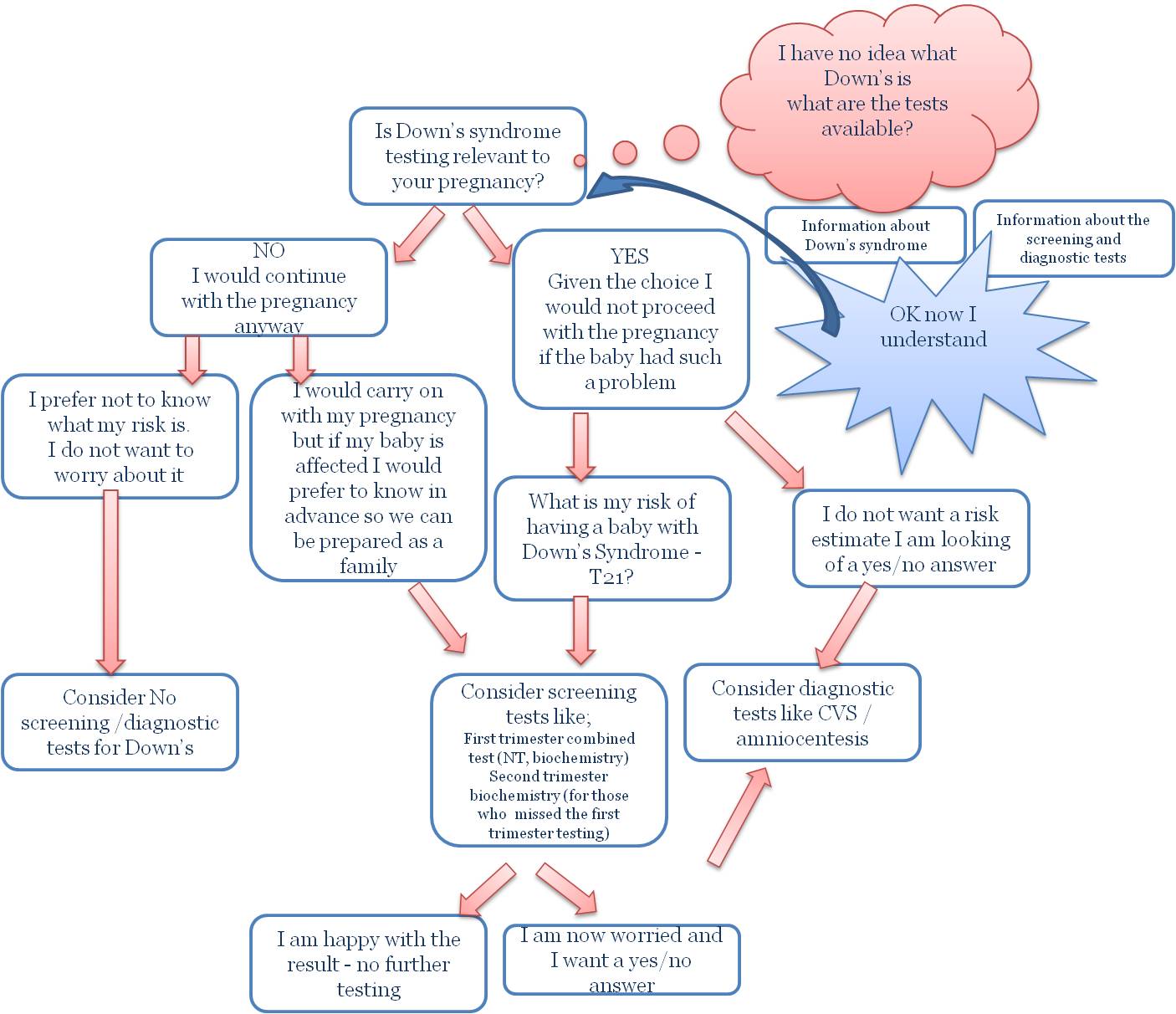
  1. Is this a relevant test?  In other words would it change the way you view this pregnancy?
  Usually parents do come in 3 big groups;
      Those for whom whether the baby has or not Downs make no difference what so ever. These parents would not consider termination and they would look after the baby the same way as any other baby would come their way.

       Those parents who believe that given the choice they would not bring to life a baby  with such a problem. 

       Those that say “Doctor I have no idea what I would do. Lets discuss what are the chances of this happening to help us make up our mind how will go forward”


For the first group testing for Downs may not be appropriate. It may result in extreme anxiety if the results are not reassuring without any real benefit for the overall pregnancy management.
I should point out here that although the majority of parents in this group would prefer not to know and worry, a small number would opt to undergo testing as they would like to be prepared (psychologically, making appropriate family arrangement etc..)


In the second group usually we see a number of parents that are looking for absolute certainty. They do not want a risk estimate but a “yes or no” answer to help them early make arrangement for the pregnancy management. For these parents  diagnostic tests like a CVS or an amniocentesis should be considered.


The third group contains the majority of parents and they should try and think the following;

  1. Is there a risk level that will make you feel content and secure?
    Unfortunately the results of screening tests give a risk estimate. The cut off points are usually set anywhere between a risk of 1/250 to 1/300. So a result 1/299 – abnormal – high risk result is statistically not different from the 1/301 – normal- low risk result. Dealing with the results of the test is challenging for everybody and you should spend some time with your doctor  discussing these issues.
  2. Avoid the question “doctor what would you do in my case?“. Each family has a unique setting. Even within the same family the circumstances change over a period of time. The role of you doctor in most of the cases should not be to tell you what to do but to give the information you need to help you make up your mind what is right for your family.   

The following flow chart is summarising the decision making process
Dr G Michailidis 
Make sure you have some quality time with your doctor and discuss the issues above. 

Remember for most of these questions there are no universally “right” answers. The correct plan is the one that is appropriately tailored to you and your family.

Dr George Michailidis, Obstetrician and Gynecologist 
Fetal and Maternal Medicine Consultant